I'm not sure I can include this US published book in my study which is a great pity because it is great; funny, moving and cleverly written. Owl is a rather odd school girl with a crush on her science teacher, Mr Lindstrom. She has no friends, lives with her strange parents in an empty crumbling mansion and never eats at school. This is because she is a wereowl, who lives by hunting small animals and can't fly if she eats human food. Owls bond for life and the fact that Mr Lindstrom is forty, balding with an ex wife and possibly a crazy son, does nothing to put Owl off. She has told her unworldly parents of her intention to marry Mr Lindstrom and they are entirely behind her, even discovering some distant connection between their families, though even they are a little bored with her obsessive observations of him. Two things happen to change things: the first is she begins to make a friend, Dawn, when she needs to borrow someone else's blood for a science experiment, her own is black; the second is that Owl sees a strange owl at the edge of her territory who is quite unable to hunt and a skinny boy has stolen Mr Lindstrom's camping equipment and is camping in the woods by his house.
Owl fights the strange owl and injures him and then when she sees a naked boy bleeding black blood onto the snow realises he is like herself, a were owl. She names him 'Houle' and enlists Dawn's help to keep him hidden and warm in Dawn's heated garage, begging various herbal cures for fever form her mother. The reader guesses some time before Owl herself that the strange boy Owl calls Houle, who looks so like herself that Dawn assumed it was her brother, is David, Mr Linstrom's son who has escaped from a mental facility. We guess too that the strange woman Owl calls 'the Wailing woman' is his wife. When Dawn tells Lindstrom that she has found his son, Owl initially believes that Dawn wants Lindstrom for herself. He wants to take the his son to his mother indoors and Owl, still in bird form attacks him and calls Houle to herself in the mating cry which forces his transformation into a bird. Dawn, finally understanding her secret, demands to talk to Owl at which point she changes back and is persuaded to allow Lindstrom to look after his son until such a time as they can be together in the human world as well as the bird one. owl realises that Dawn was never after Mr Lindstrom but another boy in their year to whom she was particularly rude to.
Owl is intelligent but entertainingly slow to grasp the intricacies of the human world, she can quote literature with ease but has little grasp of the modern world and, until invited home by Dawn, never travelled in 'an automobile' and yet she is never other than sympathetic, when watching her Mr Lindstrom from a tree as he sleeps, when struggling not to eat Dawn's hamster and beginning to grasp that her parents are not best equipped to advise her on her increasingly complicated life. It is about friendship, accommodating strangeness and learning to understand the other. Perhaps it also reminds teen readers that there is someone out there for you, even if you are an owl.
This book won the Mythopaoic Children's Fantasy Award in 1995 and also a Golden Kite. I can see why it has a great voice and a clever plot.
welcome to my world!
This site is dedicated to exploring children's fiction.
I write it, read it, teach it and increasingly feel the need to talk about. Please feel free to join the conversation otherwise it will be a monologue and they can get quite dull.
My current project is concerned with transformations in children's writing.
If you have any suggestions or favourite books which deal with transformation please let me know.
Friday, October 23, 2015
Thursday, October 22, 2015
Lady: My life as a bitch: Melvin Burgess
I came to this book with mixed feelings. It came out at the same time as my own 'Hunted' my own story of a girl turning into a fox rather than a bitch. It did incredibly well and for some undoubtedly envy based reason I never read it. Now that I have, I am relieved that it fits my remit of a book about transformation which also won prizes and I'm also disappointed. It is a really interesting idea with some excellent passages but I also found it a bit of a mess. We are stuck in the head of the protagonist, who changes her mind about who she is and what she wants constantly. I think this is probably a reasonable evocation of the thoughts of many a teenage girl, even one not also coping with a dual nature, yet that doesn't stop it making irritating, not to say, dull reading. From the very beginning we get ambiguity 'I'd been off my head lately. And it'd been great you know? Really, really great. The best time I'd ever had. Only I was getting fed up.' Sandra doesn't know why she does what she does, she seeks experience, 'fun'. Her father left when she was nine and for a while she was a hard working girl with a serious boyfriend and an astute best friend named Anne. Both girls are determined to lose their virginity before they were sixteen, because they didn't want to be told what to do with their bodies and we learn that Sandra's first time on the carpet in front of 'Stars in their eyes' left her feeling as if she'd lost something. Bored with Simon's fidelity, she finishes with him, falls out with Anne and takes up with new groups of people, stays out late, drinks takes drugs and has casual sex. 'I want everyone to fancy me. Not just the sports stars and the pop stars and all the boys. I'd like the old men and the young men and everyone to fancy me. I'd like the money in your pocket and dirt on your shoes to turn round and look at me when I go past' She has run away from her other friends to get with Wayne, and bumps into Terry a homeless alcoholic. She knocks over his can of Special Brew and in his fury he turns her into a dog because he is cursed with the power to turn people into dogs. The rest of the plot is essentially about Sandra aka Lady sometimes loving being a dog and sometimes wanting to be a person and quite often bouncing between the two. She takes up with two other victims of Terry, Fella and Mitch, who bring her a rabbit they've caught, tell her something of Terry's history and want her to join their pack. She stays with Terry for a while in the hope that he will turn her back. They are separated for a while when he is imprisoned and she runs away from him when she is on heat. When he shows her her own picture on a lamp post she goes home to try to make her mother understand that she is still Sandra albeit in dog form. Her father has returned to try and find her and she manages to convince her mother that she is indeed her daughter. 'Oh Sandra! oh, my darling, darling... She bed and scooped up with her arms., and held me tightly to her, kissing me and loving me and weeping tears too, flooding down my face. I just wanted to cry and to show her how I could cry, as if tears alone would wash me back to what I was.' It might seem as if Sandra is looking for love, but it is clear that Sandra is much loved, something which she recognises about as often as she denies it. Later when Julie her elder sister comes home she makes everyone doubt it again. Once challenged, Lady responds with fury, blaming everyone for their doubts and trashing her old bedroom. She has tried and when things go wrong, she shifts her opinion, once more her family are too quick to criticise her and in her mind have let her down. ' I was taken over by a terrible rage. I mean, who did they think they were? What right did they have to decide who I bloody was? It was the same story all over again- all people ever want to do is t judge you...... If you don't fit- out! You're a slut, you're worth nothing! Out! Out!' The family lock her in her old room and call the police and she decides to stay a dog, leaping from the window to join Mitch and Fella. 'And I thought, I don't want to be a human being. I never was a human being in the first place. I want to be quick and fast and happy and then dead. I don't want to grow old. I don't want to go to work. I don't want to be responsible. I want to be a dog!' Perhaps most readers will think she has made the wrong decision or maybe they won't. Her mother cries 'Don't go!' her younger brother 'Let her go!' and her escape into the dog world feels like a kind of abandonment.
This is no morality tale, it is barely a tale at all in that it is episodic and Sandra/Lady doesn't grow or
learn anything. I am certain that is deliberate, a kind of anti fairy story in which the frog gives up wanting to turn back into a prince. Sandra begins the story as a thrill seeking girl and ends it as Lady, a thrill seeking dog, having discovered almost nothing about herself in the hundred or so pages of introspection in between. The openness about sex, even the odd conversation about periods at one point, seem to have guaranteed the book plenty of publicity but the book itself left me feeling slightly cheated. Mitch, the other ex human dog, misses his family and never fully embraces his new state, Fella appears to, but still returns to his ex girlfriend's house to chase her cut and frighten her. Lady chooses the whole hearted acceptance of her animal self rather than the messy compromise of trying to fit in. Is the story about accepting your own nature? Is it about experiencing the sensory pleasure of life because life's a bitch and then you die? Is the reader supposed to be irritated by Sandra/Lady her self involvement and inconsistency? Is she meant to be perceived as a bitch in both senses: if you live only for sensation you cannot be part of civilised society? If you cannot control your impulses you will always be an outsider. That is certainly the case for Terry, who can't control his temper and keeps turning people into dogs which doesn't in the end do him a lot of good. I suppose you could make an argument for any of the above, but I am not convinced. With a writer of Burgess' statue I feel I should have been.
This is no morality tale, it is barely a tale at all in that it is episodic and Sandra/Lady doesn't grow or
learn anything. I am certain that is deliberate, a kind of anti fairy story in which the frog gives up wanting to turn back into a prince. Sandra begins the story as a thrill seeking girl and ends it as Lady, a thrill seeking dog, having discovered almost nothing about herself in the hundred or so pages of introspection in between. The openness about sex, even the odd conversation about periods at one point, seem to have guaranteed the book plenty of publicity but the book itself left me feeling slightly cheated. Mitch, the other ex human dog, misses his family and never fully embraces his new state, Fella appears to, but still returns to his ex girlfriend's house to chase her cut and frighten her. Lady chooses the whole hearted acceptance of her animal self rather than the messy compromise of trying to fit in. Is the story about accepting your own nature? Is it about experiencing the sensory pleasure of life because life's a bitch and then you die? Is the reader supposed to be irritated by Sandra/Lady her self involvement and inconsistency? Is she meant to be perceived as a bitch in both senses: if you live only for sensation you cannot be part of civilised society? If you cannot control your impulses you will always be an outsider. That is certainly the case for Terry, who can't control his temper and keeps turning people into dogs which doesn't in the end do him a lot of good. I suppose you could make an argument for any of the above, but I am not convinced. With a writer of Burgess' statue I feel I should have been.
Tuesday, October 20, 2015
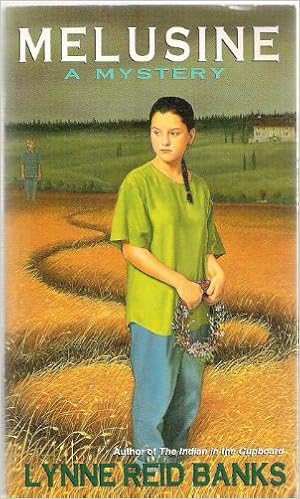
Melusine Lynne Reid Banks 1988
This is quite an odd, slightly rambling book that is very strong on atmosphere and in which, unusually, the parents of the protagonist, Roger, are allowed to play a role. It was first published in 1988 and feels like the product of a more generous age in which stories were allowed to unfold and retain some mysteries unexplained. It is rich in sensory detail, conveying the exoticism that was rural France to the middle class English and also something of the fear of the unknowable and foreign. The family's French is credibly poor and ambiguity and uncertainty about what has been seen and heard add to the tension of the story.
Roger, his parents, and his twin sisters, Polly and Emma holiday in a crumbling french chateau, inhabited by the owner Monsieur Serpe and his goat milking daughter Melusine. Serpe also claims a second daughter who has gone away. The underlying sense of menace is present from the beginning when Roger sees houses painted with question marks on their way to the chateau and from the beginning there are hints that all is not well.
Roger and Melusine become friends though she seems strange in many ways. The family explore the region, which is atmospherically described, and discover local depictions of Melusine, a mythical creature, woman by day and snake by night, who is associated with the region.
From his arrival,Roger has been disturbed by rustlings in his room at night. There have been indications of Melusine's strangeness, Roger saw her dancing the music of a 'snake charmer' in La Rochelle and when his sister almost drowns ,she saves her without apparently getting wet.
Roger observes her sitting on her father's knee and gradually understands that she is being abused by him. He confides his worries to his parents. Roger's suspicions regarding Melusine's strange nature are confirmed when at night Melusine in snake form shares his bed.
Roger and his father discover a secret underground passage which take them into the tower, a part of the crumbling chateau Melusine refused to show him. There they find a coffin in a kind of shrine. Monsieur Serpe finds them there and attempts to shoot them with his shot gun but something prevents him from hitting them. Roger sees Melusine, in snake form, over power her father, described as an 'ogre' throughout and push him from the window. He dies shouting about his daughters. Roger's father thought he was asking them to bring him 'donnez' his daughters when in fact he was asking for pardon form them ( pardonnez)
When the police arrive Melusine has disappeared, the coffin is discovered to contain the body of M's older sister who committed suicide. It is later suggested that this occurs as she too has suffered abuse at the hands of her father. After her father's death Roger finds Melusine'ss hed snake's skin and buries it. When he finds Melusine, hiding with the goat feed, ' Melusine emerged from her snake self, she was all human now, and that shedding had taken the snake look she had had, leaving her almost supernaturally new and beautiful' 198 also the distinctive characteristics of her skin had changed. When he finds the snake under his bed he knows it is Melusine when he moves her hand along her arm 'that special , warm-cool, hard-soft skin he had touched before that could only be hers' After er father's death and the burial of the skin 'It was a girls' hand that he held.'
As Melusine is orphaned and her only relative lives in Canada, Roger's family agree to let her live with them for a short time. En route to England, there is a car accident in which Roger and his mother are slightly hurt when they crash into one of the painted question marks on a wall. There is no sign of Melusine and they return home without her. Roger cannot settle and even confides his belief that she could change into a snake to a psychologist. His mother seems to understand his passion for her, and the bond between them. They find her reclaiming the chateau and trying to make it beautiful, and Roger helps her open the door of the chateau to the fresh air and golden evening sun for the first time in perhaps a hundred years.
The book is particularly interesting for its handling of Roger's growing sexual awareness; his voice breaks at a key moment in the story, when he volunteers to sleep in his own room, even after he knows about the snake; there is much emphasis on the touch of their hands, when she helps him with the milking, when he touches the snake's skin for the first time, when he finds her crying in her bed and once he accepts Melusine in snake form 'Besides, he wanted to touch her. Even like this.
The small flat head lay under his hand.
Warm cool. Rough -smooth. Pulsing softly with life.
He stroked her very gently. She lay still' p151
His growing awareness of his own feelings takes a long time to make sense and perhaps is only fully clear when his mother speaks of her own 'love' for a much older boy when he was young, but it is very clear to the reader that Melusine has a sexual hold on him. Is he tempted by snake as seductress? There are many references to the garden of Eden most obviously in the pattern of the table in their apartment in which the figure of the snake is hidden. Exiled to the guest apartments Melusine takes possession of it once she returns home as chatelaine. The folk figure of Melusine referred to in the guidebook is good woman by day and evil snake at night and yet she does no evil, though evil is done to her and her snake form appears to be a way to escape from her father.
The sexual abuse is dealt with almost entirely from Roger's perspective, he is at first only half aware of what he's seen. 'He lay awake a long time, wondering not so much what exactly he'd seen, but why it had made him feel so upset and angry...' Later, after he has slept entwined with the snake, when playing a game of 'Scruples' his family his sister makes a connection between 'abuse' and sex'. 'Roger... stared at his cards unseeingly. Sex. It was out. The word had been said and he'd heard it and couldn't pretend he hadn't. He felt suddenly so agitated that he couldn't sit still. He jumped up from the table, knocking it with his need and scattering some of the heaps of cards.' pp161 Roger begins the story as a kind of innocent in this. He is still a child, happy to talk baby talk or Woddy as they call it with his sisters at moments of stress and to be glad to take refuge in his parent's bed, but he is also on the cusp of adolescence. Once he comes to understand her strangeness he thinks that what he feels for her is pity for her difference and situation but then: 'Their hands met and held in the darkness.
Roger closed his eyes and realised for the first time that what he felt for Melusine he had never felt before. he'd thought he just wanted to help her but now he acknowledged that that was only part of it. pp167
Thursday, July 16, 2015
The Curious Tale of the Lady Caraboo: Catherine Johnson
This is not part of my reading on transformations but a bit of pleasure reading. The author is a friend and a talented writer with a great eye for the telling detail and I enjoyed every minute of this.
The story is based on true events in which a poor young woman, Mary Willcox, pretends to be from elsewhere, a game that becomes serious when the wealthy family of Knole Park House take her as their protege and take steps to prove that she is a foreign Princess. The story begins dramatically with an incident on the Malsbury Rd in which Mary is attacked and raped and recalls the loss of her baby. It is a hard hitting beginning which does not shy away from the grim reality of life for women without position in the nineteenth century. It is written from Mary's viewpoint so the reader sees both the desperation and the inventive escapism and wit that drives Mary to pose as an exotic stranger. Of course this means that the considerable tension in this book arises not from the 'Is she real or is she a fraud?' question which is so important to the other characters in the book, but from the fear of what will happen to her when her deception is uncovered. This is very well handled and the other view point characters, the privileged daughter and son, Cassendra and Fred of the house, provide an excellent foil for Caraboo. Through them the gap between Caraboo's fortunes and those of her money'd hosts is well illustrated. The reader is given an enticing and wholly convincing glimpse of nineteenth century life, which is conjured with the lightest of touches. Like all the best historical novels, this one opens a window on the past which is revealed as both familiar and startlingly strange. The issue of Caraboo's race and origins is well handled. The book gives something of the flavour of the age which makes occasionally uncomfortable reading for the contemporary reader yet as an apparent outsider Mary's identity is fluid: in fitting in nowhere she can fit in everywhere. In spite of her vulnerabilities 'Caraboo' and later Mary is a character of real strength, integrity and agency.
The romance between Mary and Fred, though unhistorical, provides a fittingly optimistic conclusion to what is a throughly compelling read.
Tuesday, March 11, 2014
Foxspell Gillian Rubenstein
I have wanted it read this for a long time - ever since it was mentioned in a review of my own 'Hunted'. I had never heard of it at the time but the sections when the boy 'Tod' becomes a fox are indeed similar to those of my protagonist Karen in so far as they focus on the sensory world and contrast the complexity of the human world with that of the animal world. Here as in my book it is the protagonist's problems with the human world which facilitate the animal transformation but in Rubinstein's story the ability to become a fox is a gift of the fox's guardian spirit, Dan Russell who rewards Tod with this gift because he buried the corpse of a young fox shot by humans. This is in many ways a more grounded story than mine with the bulk of it set in a suburb of Adelaide. Tod, his two sisters: the conscientious, hard working,' Dallas' and the wild and beautiful 'Charm' , and his mother Leonie have moved from Sydney to live with his grandmother following his father's return to London. Tod is in his last year at primary school and struggles with school work though he is a gifted painter. He makes two friends the bright and over protected Martin and Adrian whose elder brother Shaun, a graffiti artist who leads the gang 'the Breakers.' Tod is warned off exploring the landscape around his grandmother's house, a landscape of disused quarries, the railway and the depot.
There are several intertwined threads in this novel, so that it has the kind of sprawling shape that has fallen out of favour in the current publishing environment. There is the domestic story of his Tod's sisters, their mother who is trying to be a stand up comedian, using their lives as material and the acerbic tough grandmother, who keeps hens, has a much loved cat, Inkspot and defends her land against all threats. The absence of Tod's father is also significant, so that Dan Russell acts as spirit father to Tod as fox, giving him instructions that he simply obeys.pg140 '...when he had been a fox everything Dan Russell had communicated had been true, and he'd obeyed him immediately. It was only being human again that made him doubtful and scared.His fox mind had been clear and straightforward, and linked directly to his body.' Dan Russell cares for his children and would like Tod to become one of them, but his interests are not wholly human.
The second thread concerns Tod and his friendships and life out of the home. Everyone is too distracted by their own concerns to make sure he attends school.Shaun first threatens him, then invites him to join the gang and then when he rejects him pursues him 'as a fox' through the quarries. When he strikes up a relationship with Charm and produces a monumental piece of graffiti by the railway line Tod is finally persuaded to join him in order to produce some art work of his own.
The supernatural thread, which concerns Tod's affinity with the natural world underpins the whole book. Tod is literally running wild, exploring the territory and following the large fox that he has seen around the place. By following the fox he is able to evade the Breakers. The spirit fox leads him to a hidden place, reveals his strange nature and turns him into a foxboy, teaching him to hunt and teaching him about the underlying world of spirits. It is only when Dan Russell as a fox kills the cat and both of them kill his grandmother's chickens that this dream of being an animal spirit sours.
The story looks as if it might twist toward a conventional ending. It seems that Tod's father wants to come back, Dallas is going to marry the local policeman and Charm is with Shaun. Then everything changes and the plot takes an unexpected turn. The Breaker gang want to do something big and set fire to the depot and while Charm and Adrian keep watc,h Tod paints his big fox painting by the railway line. Shaun tells them about the fire then jumps on a train to escape as he knows he will be in serious trouble. Adrian tries to follow him and is killed on the tracks.
The story ends with Dan Russell answering Tod's anguished cry: ' His human was making strange sounds, no longer screaming but panting in a heavy anguished way that made Dan Russell want to snarl and run. He wanted to save his cub. He wanted to take him away from whatever made him pant like that. He barked sharply. Then he waited for his cub to look up and meet his gaze.'
The reader does not know if Tod does choose to leave the difficult human world for the simpler one of the spirits. It is exactly the kind of ending I love to write and hate to read.
Tuesday, October 30, 2012
Zook Country/Zook Land Bill Swears
I first read this in draft a few years and then as now I was struck by its energy and the strength of its no nonsense ex military narrator, Jake. I am not particularly interested in military hardware and weaponry, but his obsession with it makes perfect sense. He's a great character so out of touch with his own emotions in lock down survival mode that he fails to realise that he has rebuilt a new life after the death of his own family and his anhilation of his former platoon. Yes, this is a zombie novel, but one which largely deals with the horror of 'metamorphic plague' in the ellipses of the tale, through the evident emotional damage to Jake and his partner, Gary. Although Gary is bitten, Jake pumps him with triple the dose of antivirals so that he survives and no time is given to considering the metamorphosis from the inside. For much of the book Gary cannot kill Zooks, as they retain their human appearance, and the reasons for this are understood if not fully explored; it is not that kind of book. Instead the greater part of the story is a high action fire-fest of battling zooks and trying to live long enough to fight another day. There is enough background detail of life at the stretched edge of civilisation for the scenario to be entirely credible.
Zooks become ghasten if they survive long enough and I wanted to know more about this interesting variant on the modern zombie myth as I wanted to know more about the human who coexisted with them. However, this particular novel is set at a time of war in which the greatest drive is to fight back against the tide of the 'turned' so it makes sense not to pursue this thread too extensively. It works as it stands and if you like your action fast, your narrator laconic and your stories addictive then Zook Country is the book for you.
Tuesday, September 13, 2011
Forthcoming reviews...
My reading is slightly outpacing my reviewing at the moment so I need to remember to review:
the Ghost Drum by Susan Price,
The Island of Dr Moreau,HG Wells
Dr Franklin's Island, Ann Halam.
Pretties, Scott Westerfield
I'll try to get them done in the next few days next to read Cliff Mc Nish The Silver Child.
the Ghost Drum by Susan Price,
The Island of Dr Moreau,HG Wells
Dr Franklin's Island, Ann Halam.
Pretties, Scott Westerfield
I'll try to get them done in the next few days next to read Cliff Mc Nish The Silver Child.
Calypso Dreaming: Charles Butler
I haven't read anything by Charles Butler before and was taken aback by just how different this book is. It has an Alan Garnerish feel but the language is chewy; poetic but oddly sprung so that it doesn't hurtle forward as children's books usually do but seems to exist in a kind of a time of its own. This along with the floating omniscient viewpoint, the strange subject matter and slightly odd out of focus feel of much of it, makes for a haunting slightly hallucinatory read. I can't say I am entirely clear on the plot either.
It is set in another kind of now where there are outbreaks of leprosy in parts of the world, where there are healers and a sense that the rational world is on the cusp of breaking down.
Sweetholm an island with a tor and a long history of worship of St Brigan, once known as Brigan, is a place 'where the world is frayed'.Tansy and her parents are to stay on the island housesitting for Uncle John who is believed to have gone on a cruise. Her parents are trying to repair their marriage following her father's affair with a school friend's mother. The island is populated by locals,most notably the handyman,Davy Jones,and by a group of incomers staying at the Manor. This group includes Sophie and her strange daughter Calypso whose father transformed into a kind of a sea monster, Sal and her son Harper. Dominic, Sophie's brother is a healer priest who has come to the island to advise on Calypso, an uncanny child with almost lidless eyes who has supernatural talents and can dream things into being. Her doll, whose name is Bridget, talks to her in the night.
The story is obliquely told with much omitted. Tansy has herself dabbled in magic and for a time believes herself responsible for her father's infidelity. Her father absolves her of her guilt but her magical practise does not directly affect the plot. Dominic, urges Sophie, who is his sister to take Calypso away but she does not. He tries to smother the child as everyone on the island is infected by Calypso's Brigan influenced dreams. His sister fights him off and curses him after which he is turned into a bird and killed by gulls. Tansy and Harper get involved in trying to rescue Tansy's father who goes missing but in the end it is the sea monster father who saves everyone by destroying the Brigan's image and breaking her power. Did Calypso conjure him because Dominic gave her a box containing a flake of her father's scales?
Myth and fairy story and psychological horror are all mixed together in what is a fascinating book. Was it the dark power of Brigan herself that conspired to create Calypso? It is a book that definitely bears rereading.
Transformation seems to be a power of the old demonic forces, a way in which their power breaks through the rational, a manifestation of an older order part of the dream logic of myth and fairytale.
Friday, September 9, 2011
The Radleys: Matt Haig
This book really worked for me. It is very funny and witty but manages to stay the right side of comic pastiche. It plays with the current vampire cliches in interesting ways and while being as much about adults as teens, delivers a story with enough drama and emotional content to keep the reader engaged. I was also really pleased to read something written in part from a male point of view - almost all the books I have read recently have been written exclusively from the female point of view and I've missed male voices. If I feel like this is it any wonder that boys can feel excluded? The plot is nice and tight too which is a relief and it is good to see a bit omniscient viewpoint writing for a change - present tense too and I think that all adds to the freshness of it.
The Radleys are trying to live a normal life following the advice in 'the Abstainers Handbook' but are vampires, although at the beginning of the story the children don't yet know it. The daughter,Clara, is a vegan who, like all the family, battles ill health: headaches, weakness, sore eyes, skin rashes and insomnia. All is revealed when a boy who has been bullying Clara's brother Rowen, follows her after a party and tries to force himself on her. She bites him in self defence and finds she can't stop. In panic her father, Peter, calls on his brother Will, a wildly unreformed vampire, for help and dumps the body of Clara's victim at sea. The mother, Helen, is desperate for Will to stay away for reasons of her own. Just before her marriage he Will manipulated her into allowing him to 'convert' her to vampirism: he is also Rowan's father - both facts she has kept secret from her husband. Will gets Rowan drinking vampire blood and generally stirs things up. He is well known to the police anti vampire squad. For some time he had been immune from prosecution by special arrangement but his unwillingness to be discreet about his murdering has now changed that. When the body of Clara's victim is washed ashore with Clara's DNA all over it, the police promise Helen not to prosecute Clara if Helen kills Will. Her connection with her former lover and converter is too strong and she can't do it, but Rowan can and does. There is a nice oedipal echo when Rowan kills his father after, if not having sex with his mother, inadvertently drinking her blood, Will's most precious possession. (In revenge for Rowan smashing this bottle Will bites Rowan's girl friend leaving her all but dead) Rowan rushes to save his mother from Will's clutches and decapitates him. If this seems rather convoluted it makes perfect sense in the book. Rowan saves his girlfriend by making her a vampire and the story ends with the vampires choosing a third way between abstinence and murderous blood lust by electing to buy bottled vampire blood from a vampire nightclub. As no one is killed in the process this somehow still sits with Clara's ethical veganism.
What is unusual in a book for teens is that the mandatory sexual undercurrent comes not from the young people whose desires are either unformed or romantically innocent, but from the triangular relationship between Helen, Will and Peter. I suppose the idea of middle aged vampire sex is as intrinsically funny as the references to famous vampires in history and Will's enthusiasm for drinking the blood of goths, but it does anchor this otherwise whacky fantasy in something real. There is, in spite of the jokes, an emotional honesty here and the book ends with Helen and Pete having wild ( but not explicit) vampire sex. Vampires just like everyone else have to find their own way of dealing with temptation that doesn't involve the denial of their authentic selves.
I was also interested in the rather vehement denial of the efficacy of crucifixes and holy water as just catholic propaganda. Haig seems to belong to the school of 'secular vampirism' which deals with it as a polite kind of otherness, differently human perhaps, which disconnects it from its dark origins an evil alternate immortality - eternal death as opposed to christian eternal life. This approach works fantastically well in this book and to be fair Will is suitably despicable in a completely credible way, but it seems to be part of a trend which loses some of the resonance of the vampire legend by rehabilitating them or reinventing them for a more materialist age - or maybe its just funnier that way.
Thursday, September 8, 2011
The Switchers Trilogy: Kate Thompson
This is the first novel I have read by Thompson, though she is well regarded and I can see why. The first book 'Switchers' began quite slowly but by chapter three I was hooked. It tells the story of Tess a young girl who can switch to any form of animal she chooses. She discovers an older boy, Kevin, who has the same ability and wants her help. She also learns that this ability will only last until they are fifteen, whatever form they are in when dawn breaks on their fifteenth birthday will be their final form. Kevin encourages her to take the form of a rat and she discovers the thought-language of rats. They guide the two children to Lizzie, an old lady and former switcher who tells them that the freakish weather conditions the planet is enduring are the result of the krools, vast creatures who eat by freezing and consuming everything in their path. She believes that they can prevent the krools from killing everything and so starts an adventure which has the children travel north as birds, whales, polar bears, mammoths and finally as dragons destroying the icy power of the krools through their heat. The children's story is intersected with details of governments' attempt to sort out the problem and the dragons are attacked by planes in the arctic circle who believe they and not the unseen krools are the source of the climate change. As dragons, the children ensure that the heat of the missiles hits the krools until they retreat and the climate returns to normal. On the evening of Kevin's birthday they are returning from the Arctic when he is hit by a missile and Tess returns home alone, believing him dead. It is only some months later when she sees a strange bird outside her window that she discovers the truth, the bird is Kevin, now a pheonix, risen from the ashes of his own destruction.
This rather blunt synopsis doesn't do justice do the many threads of this plot. Tess' relationship with her parents is well done, all the characters are convincingly drawn and the passages where the children talk with the rats are particularly effective: Thompson is great on conveying the sensory joy of flying, or running as a rat. The children's gift has its own kind of logic: Lizzie, Tess and Kevin are all outsiders who discover a talent Lizzie claims is innate in everyone, (though this does not seem wholly consistent with what occurs in the last book.) Lizzie herself seems rather wise by the end of the book than she appears early on, but this might reflect the characters' understanding of her.
In 'Midnight', the second book. another switcher, Martin, traumatised by the death of his father turns himself into a vampire, hoping to live for ever. When Tess asks for his help in rescuing Kevin-as-pheonix from the zoo, Martin bites her and claims that she too is now a vampire and on her death will become his. Martin has the rats searching for a crypt for them both to sleep out the days of their eternal life and, when he reveals his plan for her on the night before his fifteenth birthday, she points out that if she became a pheonix she too would be immortal. Martin sets out to prove her wrong by attempting to kill Kevin in Pheonix form. When Kevin is liberated both he and Martin grab her and she experiences their battle for her loyalty as a fight between good and evil. She finally rejects both their versions of immortality by screaming that she wants to be human. The power of this rebuttal restores both boys to their human form. Martin finally begins to grieve for his father and remains a boy on his fifteenth birthday.
This is certainly a new take on the vampire legend and Martin and Tess' relationship lacks the romance/sexual dimension that has recently swamped the fantasy genre. The existence of the pheonix, a creature of perfect goodness requires the existence of its opposite. I found this story the least satisfactory of the three, perhaps because the vampire seems a different order creature of myth from the dragon and Pheonix and the appeal of his dark world sits oddly with Tess' joy in the natural world. It also fits less well with the morally ambiguous Celtic tradition form which the stories seem to derive. The book works because Thompson is very good, but it does at times feel rather a strain.
The third book 'Wild Blood'has Tess staying with family in southern ireland, encountering her ancestors and learning the full extent of her powers. She meets her relative who chose at fifteen to become Sidhe, live for ever and retain his powers to switch. It is Kevin, who followed her to be present on her fifteenth birthday, who points out that the world needs the wisdom of the Switchers, to protect the natural world and the magical sites of the old ones. As a consequence she elects to remain human.
All three books are strongest when rooted in the natural world.
It is worth noting that in these stories the ability to switch is seen very much as a gift which bestows wisdom and, in the final book, this philosophical link with Celtic mythology is made explicit. This gives the series a kind of coherence and consistency that shape shifting fantasies can lack.
Tuesday, September 6, 2011
The City of Bones: Cassandra Clare
This is another first book of a hugely successful series. It was an enjoyable read and sits somewhere between Harry Potter in terms of its sprawling and not wholly convincing world building and Twilight with its love triangle and forbidden sexual attraction.
The story contains many traditional elements, the heroine Clary discovers that she can see demons, werewolves, vampires and warlocks and also those who hunt them 'Shadow hunters'.It transpires that she has always had this ability but her mother, a Shadow Hunter herself paid a warlock to regularly ensorcel her to forget what she sees. Her mother has disappeared in violent and mysterious circumstances and so gradually her natural ability reasserts itself. It is a really long book with fairly predictable twists at every turn Clary is the daughter of Valentine, an evil renegade Shadowhunter determined to destroy all non humans.So, much like Harry Potter, she turns out to be rather important without knowing it in this world under the world. There were a few things that didn't make sense. Shadow hunters are made from humans with angel's blood and their talents are inherited. Clary's best friend, Simon, who predictably enough is in love with her, starts to see these other beings just because he is made aware that they exist- an expedient solution to a plot problem that seemed unconvincing.
The book is about the search for Clary's mother and for the cup which transforms ordinary humans into Shadow Hunters, but it is the sexual tension between Clary and Jace, an apparently orphaned Shadow Hunter, who turns out to be her brother, that really drives the plot.
I don't want to be over critical - quite apart from anything else crticising a very successful book can look like sour grapes - the book has some cool ideas, magical rune tattoos which lend power while they last, vampires on specially constructed motorbikes that can fly but cease to work in the light. There is the usual focus on clothes and surfaces but the book seems to belong more to the world of film and television than literature. Everyone is gorgeous and the setting cinematic. 'It's all true' is a bit of a watch word and Clare has thrown in creatures from wildly different traditions including angels and demons, without any underlying theology or ontological rationale. The Shadow Hunters have a world of their own, Idris, which also didn't make much sense to me.
It is possible I missed something: I read it at pace because it is in its way gripping but the world building felt incoherent.
I was also interested in how little the central issue - Clary's loss of her mother drove the plot. The were wolf character was not particularly convincing and it felt as if he were a were wolf only to provide another twist and the other transformation - of Simon into a rat- felt like it had come straight from a Harry Potter book.
It won't be a hardship to read the rest of the series, it is entertaining, but Clare is obviously a competent writer and I had hoped for something with a bit more depth. It is of course quite unjust to criticise a book for being the book the writer wanted to write rather than the one the reader wanted to read. This is sassy and smart and glamorous and its success is unsurprising.
Thursday, September 1, 2011
Uglies:Scott Westfield
I have returned to this as part of my project on transformations. I loved this on a first reading because of the idea, though a little googling has revealed that is was inspired by an episode of the 'Twilight Zone' which was itself based on a short story as the author is gracious enough to admit http://scottwesterfeld.com/blog/2008/01/number-12-looks-suspiciously-familiar/
It remains a great idea - children over a certain age live in dorms until at sixteen they get to choose their appearance, become 'Pretties' and accepted into the adult world.
Racial differences, height and weight extremes are all normalised to create a society of beautiful happy party people. Unfortunately the cosmetic surgery that produces this aesthetic equality also results in brain damage, the loss of curiosity, anger, creativity so that while war and ecological destruction are avoided many of those essential qualities that characterise humanity are also destroyed.
Tally Youngblood is an ugly who is marking time before she can join her best friend, Peris, in New Pretty town until she is befriended by another ugly, Shay who is even more talented than Tally at pulling 'tricks' or breaking the rules. Shay teaches Tally to hoverboard and tells her of David an older ugly who can guide them to the Smoke, a place where people can live outside of civilisation without having the operation.
Just before her sixteenth birthday Shay leaves to find the Smoke and gives instructions that Tally could follow. Tally wants the operation but is denied it by Dr Cable, an enhanced Pretty, a Special, unless Tally follows Shay to the Smoke. Tally is given a necklace which she must use to inform the Specials when she has reached her destination.
Tally overcomes a number of obstacles to reach the Smoke and after a time falls in love with David, the leader, meets his parents and learns of the damaging effects of cosmetic surgery. She destroys the necklace but in so doing calls in the Specials who capture everyone but David and Tally. Shay is transformed into a Pretty and, though David's mother has designed a pill to counter the effects of the operation, she will not give it to Shay without her consent. Ridden with guilt, Tally decides that she must be the guineapig for the pills and gives written consent before giving herself up to the Specials to be transformed into a Pretty.
This is the first of a very successful series which is fast paced and tightly written. I was a bit disappointed by the rather two dimensional world and heavy handed ecological messages, but was suitably engaged by the story. What I found interesting was that while physical transformation results in a changed personality both occur in an almost mechanistic way. The transformation is the work of science, the lesions on the brain a by product, and while the effect of beauty on the ugly is mentioned repeatedly, there is no real opportunity to explore the impact on the individual because all are a changed and all lose themselves in the process. I don't think the message is necessarily that all people who have plastic surgery are brain damaged or that beauty must be allied with idiocy more that the pursuit of the ideal physical shape might lead to the undervaluing or even the deliberate suppression of more important qualities. The idea of becoming beautiful is however a very powerful notion and in allowing Tally and Shay to become beautiful I do feel Westerfield has his cake as well as eating it. Yes Tally becomes beautiful to save her friend and ugly David is a hero, yet not being a teenager I'm not sure if fear for the potential loss of Tally's personality overrides reader satisfaction that she will finally become beautiful.
It is an intriguing concept and a fun read but it is a book about surfaces, about appearances in a rather superficial way. It is a story about betrayal and reparation, about growth in the sense that Tally recognises that beauty is not the only important quality, but, in the end the story is less about the tyranny of aesthetics than the tyranny of the Specials and I think I wanted something a little more nuanced.
Labels:
2005,
New York,
Scott Westerfield,
simon and Schuster,
Uglies
Subscribe to:
Posts (Atom)